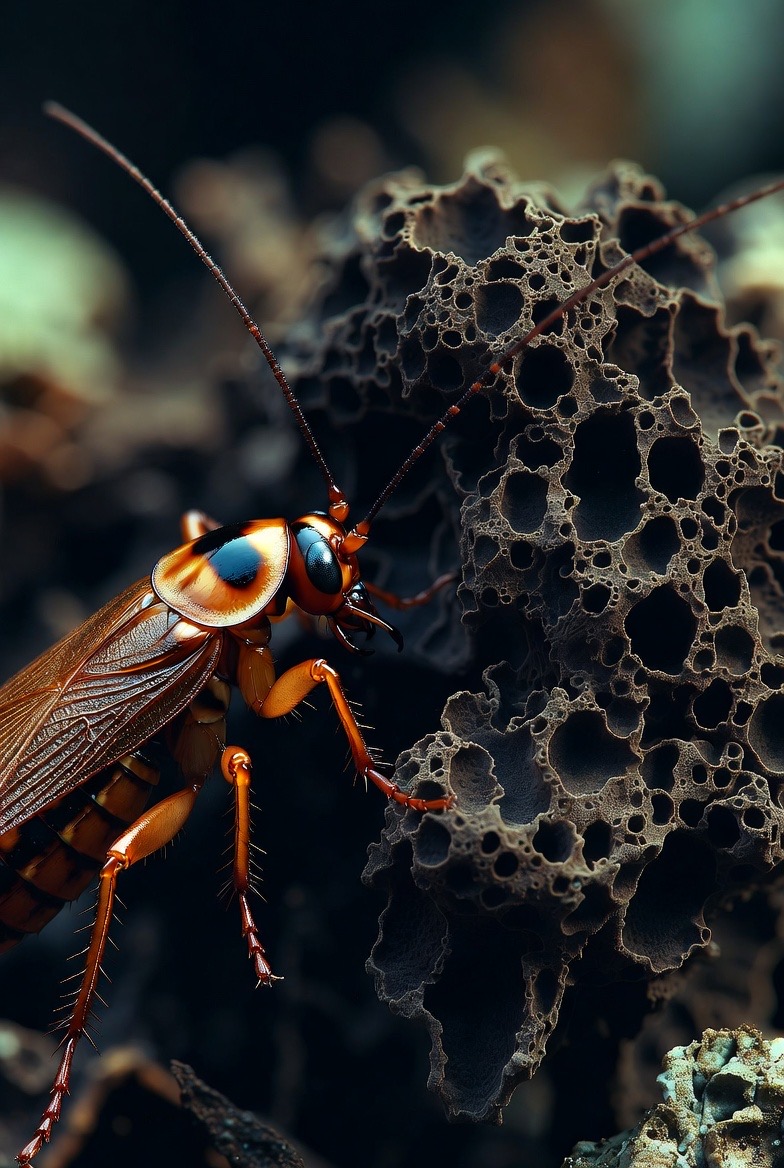
Here is a deep-dive analysis comparing cockroaches and fungi across subatomic physics, cognitive science, evolutionary biology, and pharmacology.
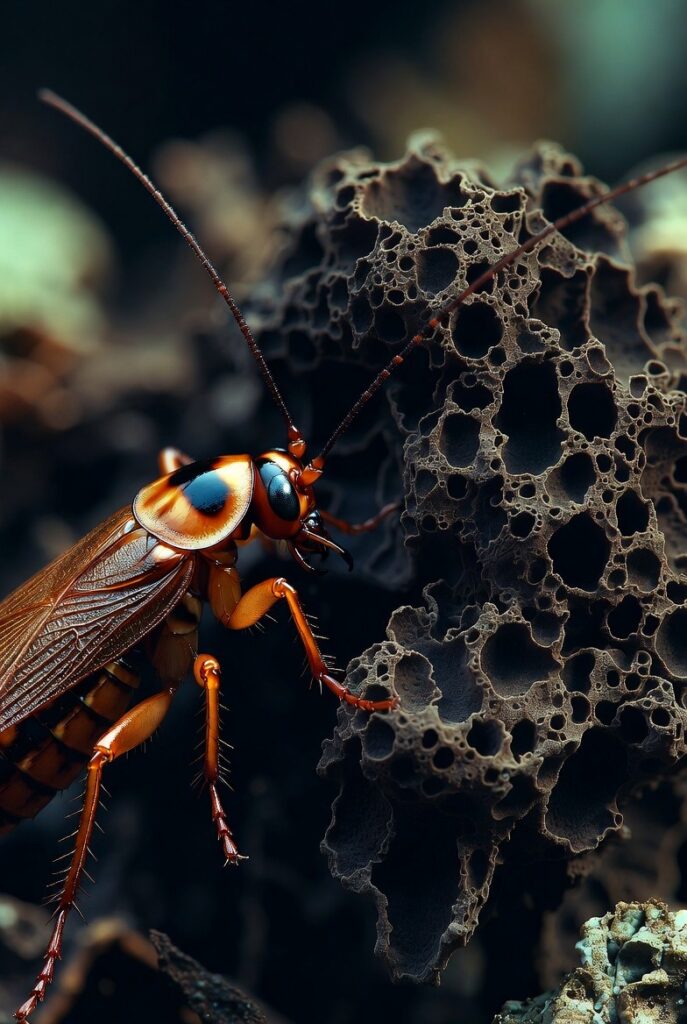
To differentiate a cockroach (Periplaneta americana) and a fungus (Saccharomyces cerevisiae or Aspergillus niger) at the subatomic level, we must look at the structural distribution of their biological matter.
All biological matter is composed of atoms (Carbon, Hydrogen, Oxygen, Nitrogen), whose nuclei contain protons and neutrons. At the quantum level, these nucleons are made of quarks:
• Protons consist of two “up” quarks and one “down” quark (uud), giving them a positive charge.
• Neutrons consist of one “up” quark and two “down” quarks (udd), rendering them neutrally charged.
Carbon, Oxygen, and Nitrogen possess an equal number of protons and neutrons, meaning they contain an exact 1:1 ratio of up quarks to down quarks. However, Hydrogen contains one proton and zero neutrons, meaning it contributes two up quarks and only one down quark to an organism’s total biomass.
A cockroach’s dry weight consists heavily of proteins and lipid fats. Lipids have a massive proportion of Hydrogen atoms relative to Carbon and Oxygen. Conversely, fungi are largely built from chitin and neutral carbohydrates, which have lower Hydrogen densities relative to Oxygen. Therefore, if you were to calculate the absolute subatomic composition of both organisms, the lipid-heavy cockroach possesses a mathematically higher ratio of up-quarks to down-quarks across its total biomass compared to the carbohydrate-heavy fungus.
Energy, Space, Time, and Consciousness
Despite their biological differences, both organisms operate under the universal laws of metabolic scaling (often related to Kleiber’s Law), which dictate how energy use and the perception of “biological time” scale proportionately with mass (m^{1/4}).
Their approaches to space and consciousness, however, represent entirely different cognitive architectures:
• Cockroach (Centralized Consciousness): Cockroaches navigate space using a centralized nervous system, brain, and ganglia. Behavioral studies show that cockroaches possess individual “personalities” and decision-making capabilities; when introduced to a new space, some individuals will act cautiously and hide, while others are audacious and explore.
• Fungus (Decentralized Consciousness): Fungi lack a brain entirely, yet demonstrate what scientists theorize is “cellular consciousness.” Mycelial networks can navigate space, allocate resources, and even pass cognitive tests. In recent studies, fungi successfully recognized and maintained spatial memory of geometric shapes (like circles and crosses) over long periods. To quantify this brainless intelligence, researchers apply the Integrated Information Theory (IIT), calculating the \Phi (phi) value of the fungal network’s ability to communicate, store memory, and adapt collectively.
Evolutionary History and Projections (2100)
• Cockroaches: They are among the planet’s oldest survivors, having existed for roughly 300 million years. While the myth that they could happily survive the epicenter of a nuclear bomb is false, they can withstand 6 to 15 times the lethal radiation dose for humans because their cells divide much slower, reducing radiation damage. In climate change models projecting toward the year 2100, cockroaches are expected to easily adapt to warming habitats, out-surviving humans.
• Fungi: Fungi are expected to thrive in a warming world. Studies simulating Intergovernmental Panel on Climate Change (IPCC) scenarios for the year 2100 show that higher global temperatures will exponentially increase fungal mycelium growth rates and atmospheric spore production.
The Evolution of Cockroaches into Termites
Termites are essentially “social cockroaches” that evolved from a solitary, wood-feeding cockroach ancestor approximately 150 million years ago.
This massive evolutionary leap was entirely facilitated by symbiotic microbes. The ancestral cockroach ingested cellulolytic protozoa and bacteria, allowing it to digest wood (lignocellulose). This internal gut symbiosis eventually pushed the insects to develop eusocial behaviors to share these microbes. Approximately 30 million years ago, “higher” termites (Macrotermitinae) took this a step further by developing an ectosymbiosis with Termitomyces fungi. Instead of digesting the wood internally, the termites began actively farming the fungus in their nests, outsourcing the digestion of the wood to the fungal mycelium.
Effects and Similarities to Alcohol and Weed
Fungi and cockroaches share fascinating neurochemical and biological overlaps with human recreational substances:
• Fungal Production: Fungi (specifically yeast) are the biological engines that create alcohol via fermentation. More recently, synthetic biologists have successfully genetically engineered fungi (like Aspergillus niger) to biosynthesize cannabinoids, effectively producing THC and CBD without the need for a cannabis plant.
• Cannabis-Fungi Links: The cannabis plant itself relies on a massive mycobiome (fungal network) to survive. Ironically, this means raw marijuana is often naturally contaminated with fungi that produce toxic secondary metabolites (mycotoxins), posing health risks to immunocompromised users.
• Insect Pharmacology: Cockroaches possess a complex nervous system complete with dopamine and octopamine receptors. When exposed to stimulants like cocaine or amphetamines, cockroaches display erratic, drug-seeking behaviors similar to human addiction. Conversely, when spiders (another household arthropod) are exposed to marijuana, their spatial intelligence is impaired, resulting in disorganized, erratic web-building.
Leave a Reply